Police Vehicle Replacement Standards shape when agencies retire and replace patrol cars to balance safety, reliability, budgeting, and compliance. This guide explains the objective framework agencies use—vehicle lifecycle planning, performance metrics, and procurement controls—then shows how buyers can find a cheap car for sale by comparing reputable dealer listings like Cars.com, Carmax, CaronaSale, and Autotrader.
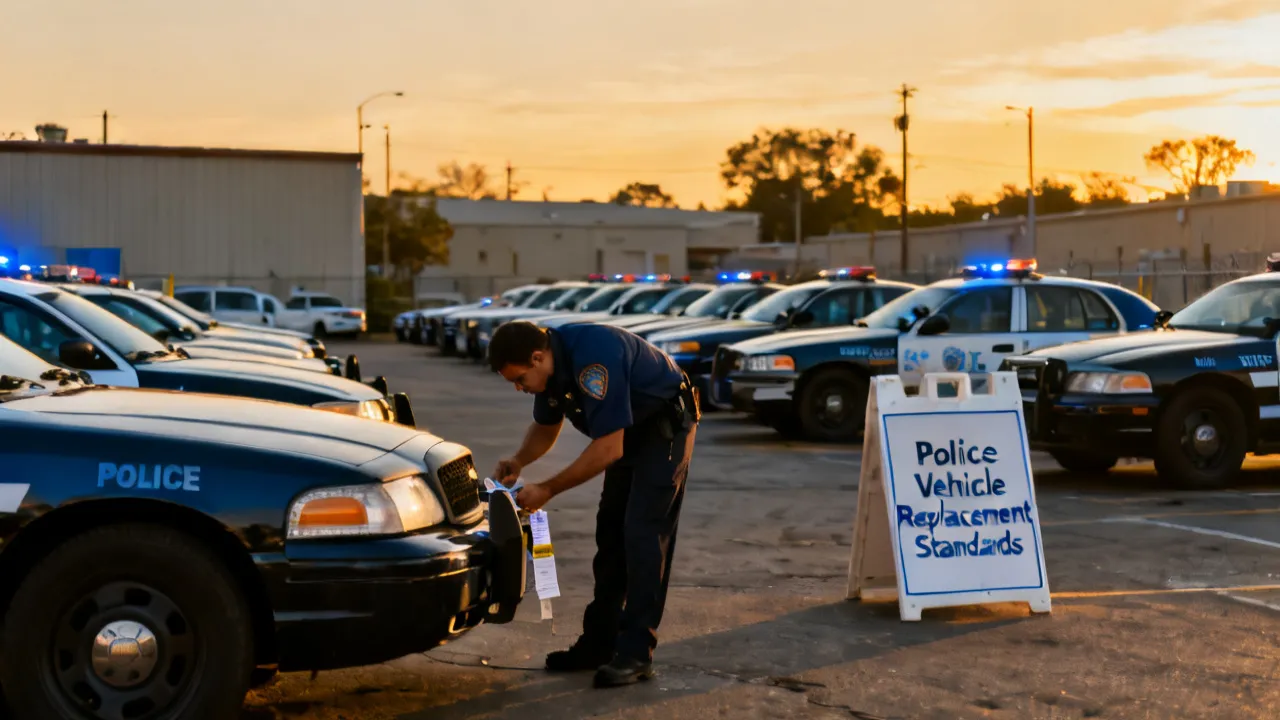
Police Vehicle Replacement Standards are ultimately about risk management: agencies replace vehicles when total lifecycle cost rises, safety margins shrink, or mission reliability becomes harder to sustain. A strong replacement program typically combines (1) fleet utilization and maintenance history, (2) safety and compliance checks, and (3) disciplined procurement planning—so that replacement decisions are defendable, consistent, and financially responsible.
When done well, these standards do more than prevent mechanical breakdowns. They also create a predictable pipeline for procurement, training, and outfitting, reduce variability in fleet performance, and help leadership explain decisions to oversight bodies, auditors, and—directly or indirectly—to the public. In many agencies, a replacement policy is also a governance instrument: it limits discretionary “one-off” decisions and ensures that spending follows documented criteria rather than political pressure or internal urgency.
From an industry expert perspective, the very effective police fleet programs do not rely on “mileage alone.” Instead, they treat each vehicle as a measurable asset over time. Police vehicles often see extended idling, frequent stop-and-go driving, harsh weather exposure, and specialized equipment loads—conditions that can accelerate wear in brakes, tires, cooling systems, lighting, and electrical components. In this environment, replacement criteria must be precise enough to reduce downtime while still supporting transparent budgeting.
It’s also important to recognize the operational consequences of waiting too long. Older vehicles can still “run,” but they may not run reliably under the exact conditions required for emergency response: rapid acceleration on short notice, predictable braking performance in wet or icy conditions, stable cooling system behavior after long idle periods, consistent electrical output for radio/computer systems, and secure cabin mounting for critical gear. When those factors degrade, the result is often not a total breakdown—it’s intermittent failures, escalating warnings, and repeated service events that pull resources away from other maintenance priorities.
Additionally, replacement standards impact morale and culture. Maintenance teams often feel pressure when they have to keep aging vehicles operating with limited parts availability or rising labor demand. A clear policy reduces the feeling of “blanket emergency repairs” and supports staffing planning. It also helps operators understand that vehicle availability is linked to a long-term program rather than ad-hoc decisions.
Very reputable agencies build standards around measurable and auditable inputs. While exact thresholds vary by region, vehicle type, and mission profile, the logic is consistent: replacement should occur when the vehicle no longer delivers the top value relative to alternatives.
A modern replacement policy also anticipates constraints. For example, if the local market experiences procurement delays—supply chain disruptions, vendor backlogs, or extended upfit schedules—the policy must still allow the agency to replace vehicles that have become unsafe or unreliable. In that scenario, a replacement policy should include escalation procedures: what leadership authorizes, what documentation supports approval, and how exceptions are tracked.
To make these components practical, agencies often operationalize them into a structured scoring model or a “tiered decision tree.” For instance, a vehicle may be placed in a “watch status” when maintenance costs exceed a certain percentage of replacement cost, but it may only be authorized for replacement when specific safety or readiness thresholds are also met. This approach prevents a policy from becoming either too rigid or too vague.
It is tempting to reduce replacement to a single metric like odometer reading. However, an expert approach weighs multiple signals. Two vehicles with identical mileage can have very different maintenance profiles if one experienced frequent towing, extreme weather, or heavy idling. For police fleets, lifecycle standards generally outperform mileage-only rules because they reflect the realities of duty cycles.
Practical takeaway: If an agency uses a mileage threshold, it should be supported by maintenance cost indicators and inspection outcomes so that decisions remain defensible when circumstances differ.
To illustrate, consider two patrol sedans approaching the same mileage. Vehicle A might be driven mostly on relatively flat roads with moderate traffic, while Vehicle B might spend substantial time in congested areas, perform frequent hard stops, and endure long idling sessions while equipment is in continuous use. Even if both vehicles “hit 100,000 miles,” the one with heavier stop-and-go and extended idling typically faces earlier brake wear, higher tire wear, more frequent cooling-related service calls, and accelerated electrical load stress. A lifecycle policy recognizes those differences, which reduces the likelihood of replacing the wrong vehicle at the wrong time.
Replacement standards often treat vehicles differently by role:
Even within “police cars,” the duty cycle differs—so standards should reflect that differentiation.
For example, K9 transport vehicles may have additional considerations: interior surfaces and ventilation requirements, ease of cleaning, reliability of climate control during transport, and safe restraint systems for animal security. These elements can degrade differently than ordinary patrol cabin components. Traffic units can carry heavy equipment like radar systems, speed measurement tools, and additional lighting. That means suspension components may wear differently, and roof-mounted or trunk-mounted equipment may complicate future upgrades and repairs.
Command vehicles often have longer dwell time on the road but may be used for events with limited driving and high equipment uptime (communications gear running for long periods). That equipment uptime can stress alternators and battery systems. In those cases, an agency might replace earlier when charging system failures become more common or when reliability of critical communications gear is affected.
A replacement policy is most effective when it is both specific and enforceable. If criteria are too general, exceptions become frequent and the standard loses credibility. If criteria are too strict, agencies may replace vehicles that still have remaining useful life, wasting budget and increasing environmental impact.
One method is to set baseline thresholds plus conditional triggers. Baseline thresholds may include target service life ranges by vehicle class (e.g., typical patrol life) and minimum utilization metrics. Conditional triggers define events that accelerate replacement regardless of whether baseline thresholds have been reached.
For example:
This structure allows an agency to explain decisions clearly: a vehicle was not replaced solely because of age; it was replaced because risk and total cost became unacceptable compared with the alternatives.
From a fleet management standpoint, replacement standards are not only about the retirement moment—they also influence procurement quality and downstream maintenance. Agencies can strengthen outcomes by using:
Procurement controls also help with “hidden failure modes.” For instance, agencies often discover after installation that certain vehicles have insufficient alternator capacity, inadequate thermal management for prolonged electrical load, or wiring harness routing that becomes vulnerable to vibration-induced damage. By strengthening specifications, fleets reduce the likelihood that they will purchase vehicles that appear acceptable at delivery but fail under real operational stress.
Another common improvement is to treat upfit (or equipment installation) as part of lifecycle planning rather than a one-time add-on. This means evaluating:
When these factors are considered upfront, agencies avoid expensive “rework cycles” later.
When replacing or upgrading vehicles—whether for fleet needs or individual purchases—buyers often benefit from transparent listings, photos, and vehicle history disclosures where available. Below is a brief comparison of reputable online platforms used for browsing vehicles on sale.
| Website | What it’s useful for | Example of listings focus |
|---|---|---|
| Cars.com | Wide discovery of vehicles with dealer inventory and detailed listing pages | New and used inventory search |
| Carmax | Structured buying experience with extensive inspection process emphasis | Used vehicle shopping with standardized handling |
| CaronaSale | Marketplace browsing to compare vehicles on sale across listings | Cross-listing comparison |
| Autotrader | Broad search for vehicles on sale with inventory aggregation | Dealer and private seller listings |
Source: Information from the official websites listed below.
source: [www.cars.com](https://www.cars.com/), source: [www.carmax.com/cars](https://www.carmax.com/cars), source: [www.caronsale.com/en](https://www.caronsale.com/en), source: [www.autotrader.com](https://www.autotrader.com/)
Even if your goal is fleet replacement, the same disciplined approach helps individuals find value. Below is a practical process to locate a cheap car/car on sale while reducing the risk of hidden costs.
The biggest difference between “cheap on the sticker” and “cheap in ownership” is the gap between what you pay and what you must spend next. That includes immediate repairs, maintenance catch-up, insurance implications, fuel economy differences, and parts availability. A step-by-step process helps separate genuine value from sales-driven optics.
To connect the idea of vehicle replacement standards with real buying discipline, consider the following requirements checklist. This is designed to help you make consistent decisions.
Even when buying for personal use, you can apply a “replacement standard mindset” by requiring objective proof rather than relying on trust. A consistent checklist reduces buyer bias and prevents “cost shifts” to the buyer after purchase.
| Decision point | Requirement/condition | Why it matters |
|---|---|---|
| Safety and compliance | Confirm inspection results, tire condition, brake condition, and lighting functionality | Reduces the likelihood of costly immediate repairs |
| Maintenance credibility | Verify service records or reliable history documentation | Helps estimate future maintenance and lifecycle cost |
| Equipment compatibility (if applicable) | Ensure the vehicle can support your operational technology (mounting points, electrical capacity) | Avoids upgrade bottlenecks and unexpected retrofit costs |
| Total cost view | Consider taxes, registration, insurance, and first-year maintenance | Prevents “cheap price” from turning into expensive ownership |
A disciplined replacement standard typically produces three outcomes: fewer unexpected failures, improved readiness rates, and budgeting that becomes easier to forecast. In practical terms, an agency that documents triggers (maintenance cost escalation, inspection failure trends, and technology obsolescence) can better justify when it replaces and when it retains vehicles.
For clarity, consider the following “inverted pyramid” logic:
In real operations, this logic prevents a common failure: replacing because a procurement cycle is convenient, even when vehicles remain safe and cost-effective. That can create an avoidable budget hit without meaningful risk reduction. Conversely, it also prevents the opposite failure: keeping vehicles too long because the budget hasn’t released funds, even when safety risk is increasing.
Replacement standards succeed when they produce records that can be audited and reviewed. “Good documentation” is not only a policy binder; it’s an operational dataset that ties each decision to evidence. Ideally, agencies maintain a structured vehicle record that includes:
When these fields exist, decision-makers can compare replacement candidates consistently. It also helps when agencies transition fleet management software or when staff change roles; continuity is maintained because the data is complete.
Not all failures carry the same operational or safety consequences. A mature replacement program acknowledges risk categories. For instance:
By separating risk categories, agencies can justify earlier replacement when critical safety or mission-critical systems are involved—even if maintenance costs are not yet at the highest levels.
Even if a fleet department has a perfect replacement trigger, it can fail operationally if it cannot align with procurement lead times. Police vehicles are often dependent on multiple schedules: vehicle manufacturing timelines, vendor delivery windows, equipment upfit scheduling, and training readiness. Therefore, agencies should plan replacements using lead times as a structural element, not an afterthought.
Lead-time planning typically requires agencies to ask:
A practical approach is to replace vehicles in cohorts. For example, an agency might schedule replacements for several vehicles during a period when the upfit shop has capacity, rather than replacing one vehicle at a time. Cohort planning can reduce per-unit cost and reduce the risk that a lack of shop time creates operational gaps.
One of the hardest fleet management questions is not “when should we replace?” but rather “should we retain for one more year?” A lifecycle policy provides a method to answer that question using tradeoffs.
A useful retention/replace evaluation may involve:
When projecting, agencies should avoid simplistic linear assumptions. A vehicle’s maintenance cost can escalate nonlinearly due to component interactions. For example, a cooling system problem can lead to overheating, which can affect other components and increase the complexity of future repairs. A good replacement program incorporates that “escalation risk” into retention decisions.
Lifecycle cost is often misunderstood as “what we pay in repairs.” For replacement standards, lifecycle cost should also include indirect costs and opportunity costs. These may include:
When these costs are counted, a replacement decision becomes more robust. A vehicle might appear cheap to keep because its maintenance bills are manageable so far; however, if it creates frequent downtime, it can cost the agency far more than the invoices suggest.
Safety and compliance checks are central to replacement standards. However, safety outcomes are only useful if inspections are consistent across time and across personnel. Agencies can improve comparability by standardizing:
Standardization helps avoid “paper compliance,” where vehicles pass because the inspection process is inconsistent rather than because the vehicle is actually safe. It also helps fleet managers identify recurring defects by pattern—something that supports decisions about retention or replacement.
Utilization data is valuable, but agencies should interpret it responsibly. In some fleets, mileage is influenced by assignment practices: some officers may drive certain vehicles more often due to shift scheduling or preference. Similarly, idling time can vary based on enforcement style, traffic conditions, and local climate.
To avoid misleading signals:
This is one reason lifecycle standards are often more defensible than mileage-only standards. They incorporate the operational realities behind utilization, rather than treating mileage as an automatic proxy for wear.
Police technology evolves. Radios, cameras, computer systems, and data connectivity tools change in both performance and software requirements. Replacement standards must anticipate technology evolution because an older vehicle platform can become “stuck” if:
Modernization constraints can create a false economy. Agencies may keep older vehicles because repairs are “not too expensive,” but then they spend disproportionate amounts upgrading each vehicle, with frequent rework to address fit, compatibility, and reliability issues.
A good replacement standard can address this by incorporating a modernization score or by defining “upgrade feasibility” thresholds. For example, a vehicle might be retained only if it can be upgraded to meet the next system generation without major rework or without compromising safety.
Replacement decisions affect not only garages and procurement but also operators. When a new platform is introduced, training requirements may include:
A thoughtful replacement program reduces resistance by planning training alongside procurement. It also ensures that operators report issues early rather than continuing to drive vehicles that have developing faults. Early reporting can reduce maintenance escalation and improve overall replacement planning.
Even if an agency has a policy on paper, it must validate whether that policy produces the expected results. Agencies can monitor performance using metrics such as:
These performance indicators help agencies refine replacement standards over time. For instance, if the agency discovers that a certain model has unusually high electrical component failure rates after a particular year, it can tighten criteria or adjust procurement specs for that platform.
The logic behind replacement standards can be adapted to individual buyers looking for value. Fleet managers do not want to buy vehicles that appear cheap but become expensive due to recurring repairs, safety risks, or maintenance unpredictability. Similarly, individuals benefit from treating purchases as lifecycle decisions.
When you shop on marketplaces, you can apply a “mini replacement policy” mindset:
This approach reduces regret and helps buyers avoid the “cheap car trap” where a low purchase price becomes a high total cost due to neglected maintenance.
Even if your goal is fleet replacement, the same disciplined approach helps individuals find value. Below is an expanded process to locate a cheap car/car on sale while reducing the risk of hidden costs. The steps below emphasize safety, documentation, and cost predictability.
For individuals, marketplaces can be extremely useful for discovery, but the real value comes from verification. Treat every listing as a starting point, not proof of condition. The PPI (or another credible verification method) is the bridge between listing claims and ownership reality.
To connect the idea of vehicle replacement standards with real buying discipline, consider the following requirements checklist. This is designed to help you make consistent decisions while also highlighting items that are often overlooked.
| Decision point | Requirement/condition | Why it matters |
|---|---|---|
| Safety and compliance | Confirm inspection results, tire condition, brake condition, and lighting functionality | Reduces likelihood of costly immediate repairs and safety risk |
| Maintenance credibility | Verify service records or reliable history documentation | Improves future maintenance cost prediction and avoids “catch-up” surprises |
| Mechanical integrity | Ask about check engine history, overheating incidents, transmission behavior, and unusual noises | Prevents hidden problems that can escalate quickly |
| Equipment compatibility (if applicable) | Ensure the vehicle can support your operational technology (mounting points, electrical capacity) | Avoids upgrade bottlenecks and unexpected retrofit costs |
| Total cost view | Consider taxes, registration, insurance, and first-year maintenance | Prevents “cheap price” from turning into expensive ownership |
| Parts and service availability | Confirm parts availability and typical repair turnaround time | Reduces risk of long downtime and inflated repair costs |
A disciplined replacement standard typically produces three outcomes: fewer unexpected failures, improved readiness rates, and budgeting that becomes easier to forecast. In practical terms, an agency that documents triggers (maintenance cost escalation, inspection failure trends, and technology obsolescence) can better justify when it replaces and when it retains vehicles.
For clarity, consider the following “inverted pyramid” logic:
To operationalize that logic, agencies can adopt a multi-step decision process:
Top practice is to use a combination. Mileage and years can be inputs, but agencies usually get more reliable outcomes by also tracking maintenance history, inspection results, and operational duty cycle (including idling and harsh-use patterns).
Common justification metrics include repair frequency, maintenance labor hours, major component repair costs, inspection pass/fail trends, downtime rates, and—where relevant—equipment integration constraints that affect mission readiness.
Agencies can prevent early replacement by setting retention thresholds tied to objective indicators—such as stable inspection outcomes and manageable maintenance cost trends—then reviewing vehicles periodically through fleet audits.
Use comparable listings, verify maintenance records when possible, obtain a pre-purchase inspection, and negotiate based on documented issues. A “cheap” price only remains cheap if first-year ownership costs are predictable.
They are useful for discovery and comparison, but reliability depends on the specific listing details and seller transparency. Buyers should confirm key documents and complete an inspection before purchase.
Inspections reduce uncertainty. For fleets, pre-delivery inspection helps ensure the vehicle meets baseline specifications before equipment installation. For individuals, pre-purchase inspection helps identify safety or mechanical issues that would increase total cost.
Police Vehicle Replacement Standards are very effective when they combine objective safety and reliability indicators with lifecycle cost reasoning. Whether you are an agency building a fleet policy or a buyer trying to find a cheap car on sale, the same principle applies: decisions should be grounded in evidence, not assumptions. Use reputable sources to compare inventory, verify the vehicle’s maintenance story, and align purchase timing with total ownership cost. In doing so, you improve readiness for fleet operations and reduce financial surprises for individual ownership.
When agencies treat replacement standards as a living governance tool—reviewing performance metrics, updating thresholds when real-world data changes, and tightening procurement specifications—they create a cycle of continuous improvement. This helps ensure that every replacement decision meaningfully improves public safety and fleet efficiency, rather than simply reacting to aging assets.
Disclaimer: The above information is compiled from online resources, and the data is as of October 2023. For more information, please refer to the official website of the relevant platform or authority.
Reference links (including all links used above):
[www.cars.com](https://www.cars.com/), [www.carmax.com/cars](https://www.carmax.com/cars), [www.caronsale.com/en](https://www.caronsale.com/en), [www.autotrader.com](https://www.autotrader.com/)
Police Vehicle Replacement Standards and Fleet Buying
Police Vehicle Replacement Standards and Buying Used Cars
Police Vehicle Replacement Standards Explained
Police Vehicle Replacement Standards Explained for Fleet Teams
Police Vehicle Replacement Standards and Buying Options
Police Vehicle Replacement Standards Explained
Police Vehicle Replacement Standards and Safer Procurement

Police Vehicle Replacement Standards and Fleet Buying Guide
Police Vehicle Replacement Standards and Buying Guide
Police Vehicle Replacement Standards and Fleet Buying
This guide explains how Police Vehicle Replacement Standards shape budgeting, safety, and readiness for departments, while showing how to find a cheap car on sale through reputable marketplaces. It also provides objective steps for evaluating replacements—mileage, lifecycle costs, safety equipment, and compliance—using practical criteria you can apply whether you’re sourcing marked units or general-purpose vehicles.
Police Vehicle Replacement Standards and Buying Used Cars
This guide explains Police Vehicle Replacement Standards and how agencies evaluate fleet age, condition, safety, and readiness—then translates those same discipline-driven checks into a practical process for finding a cheap car on sale. It introduces major official trading platforms, offers a comparison framework, and provides expert-style requirements and FAQs. Objective, compliance-focused, and built for real-world decisions.
Police Vehicle Replacement Standards Explained
Police Vehicle Replacement Standards shape when agencies retire and replace patrol cars to balance safety, reliability, budgeting, and compliance. This guide explains the objective framework agencies use—vehicle lifecycle planning, performance metrics, and procurement controls—then shows how buyers can find a cheap car for sale by comparing reputable dealer listings like Cars.com, Carmax, CaronaSale, and Autotrader.
Police Vehicle Replacement Standards Explained for Fleet Teams
Police Vehicle Replacement Standards shape how agencies decide when to retire, repair, or replace patrol cars and support units to maintain safety, reliability, and readiness. This guide outlines the objective criteria fleets commonly use—mileage, condition, cost-to-maintain, and mission requirements—then compares official dealer marketplaces and explains how to find and buy a reasonably priced car for fleet or backup needs.
Police Vehicle Replacement Standards and Buying Options
Police Vehicle Replacement Standards define when fleet agencies should retire and replace patrol cars based on safety, reliability, and operational readiness. This guide explains how replacement standards work, how to evaluate vehicles like any other used-car purchase, and where to find current listings on major official car trading websites. It also outlines a practical decision checklist and key requirements.
Police Vehicle Replacement Standards Explained
Police Vehicle Replacement Standards guide agencies in deciding when to rotate patrol and support fleets, balancing safety, reliability, cost control, and regulatory expectations. This guide explains how standards are typically built, what to document during replacement planning, and how to find and compare discounted vehicles. It also summarizes key purchasing steps using reputable car trading websites.